
Introduction
Artificial intelligence is rapidly transforming healthcare across the United States and Canada.
From diagnostic support to predictive analytics, clinical AI is receiving significant attention and investment. Healthcare organizations are adopting technologies that enhance decision-making, improve accuracy, and support better patient outcomes.
However, this raises an important question:
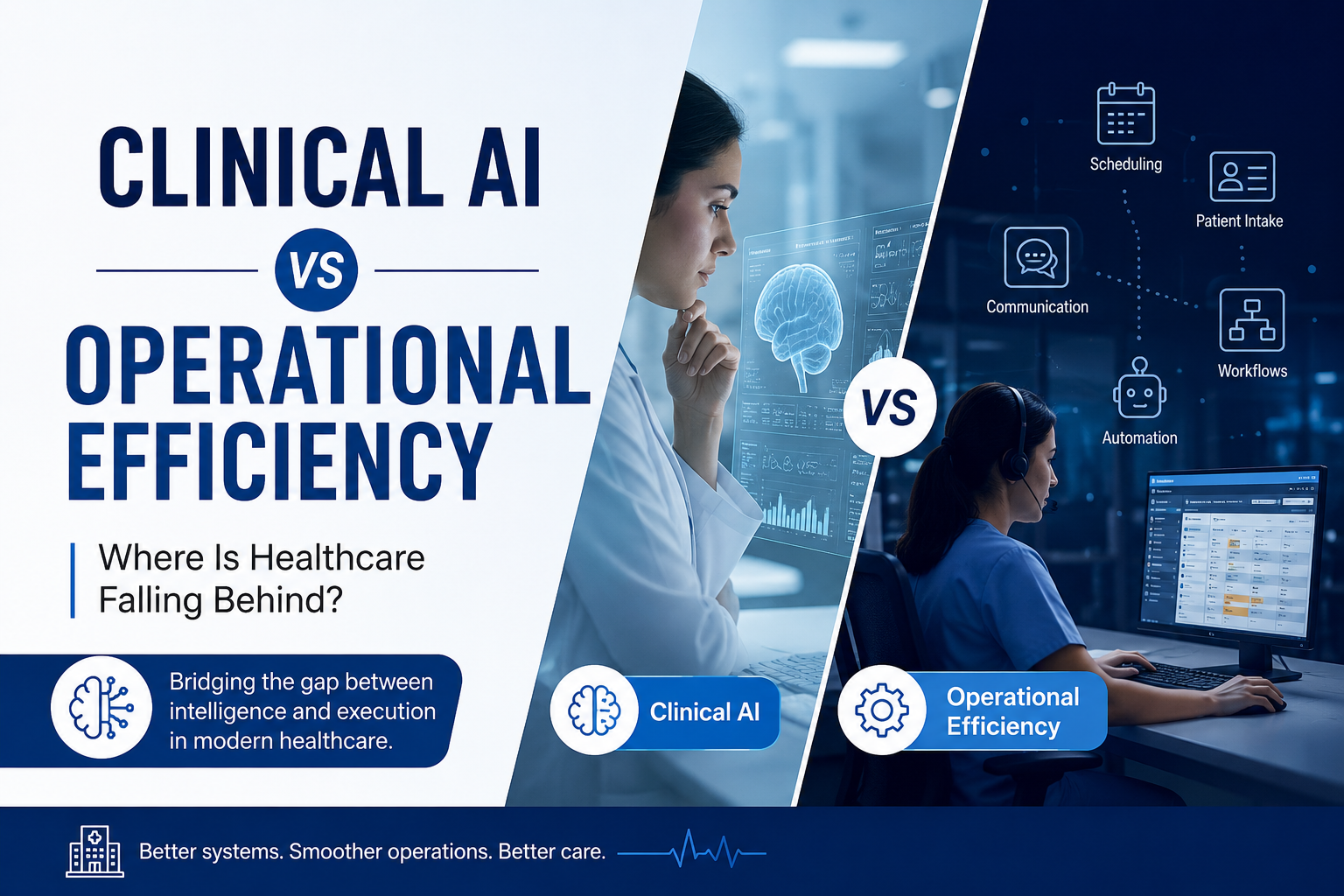
Is healthcare focusing too heavily on clinical intelligence while overlooking operational efficiency?
This shift is increasingly visible across healthcare discussions, industry reports, and practitioner feedback.
In a recent poll among healthcare professionals, responses highlighted a strong interest in clinical AI. At the same time, a substantial portion pointed toward operational workflows and administrative processes as areas where improvement is equally critical.
This suggests a growing gap between innovation in care delivery and efficiency in execution.
The Rise of Clinical AI
Clinical AI has become the centerpiece of modern healthcare innovation.
Common applications include:
- Diagnostic imaging support
- Clinical decision assistance
- Risk prediction models
- Personalized treatment recommendations
These tools are helping clinicians:
- Improve diagnostic accuracy
- Reduce variability in care
- Enhance patient outcomes
As a result, clinical AI is often viewed as the most impactful area of technological advancement in healthcare.
However, focusing primarily on clinical innovation can leave other parts of the system under-optimized.
What Healthcare Professionals Are Prioritizing
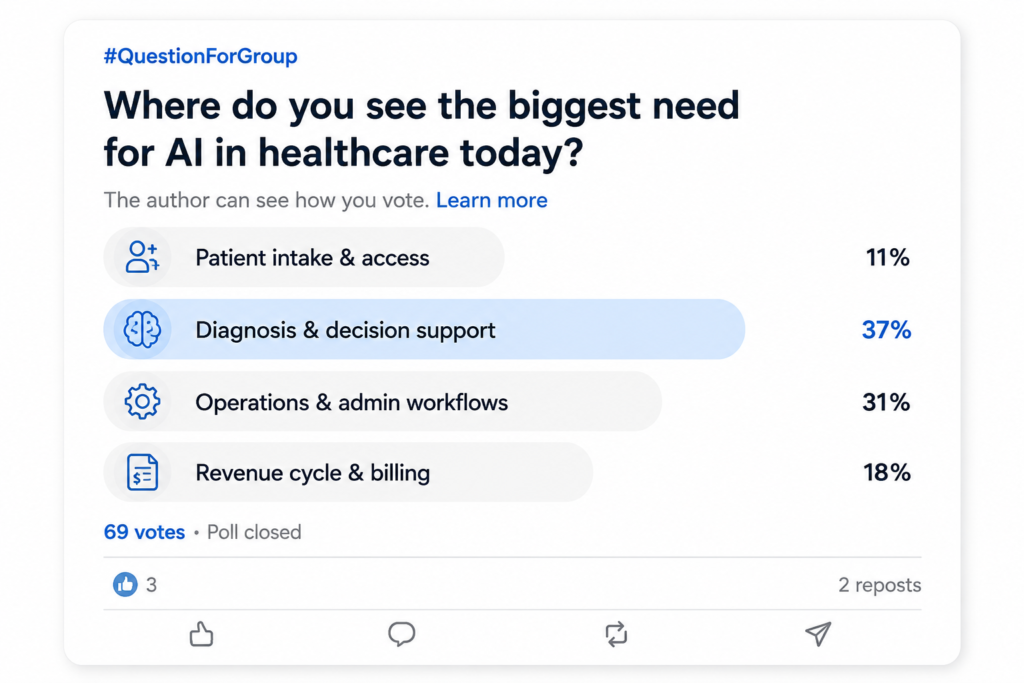
A recent poll among healthcare professionals asked a simple question:
Where is AI needed the most today?
The responses showed a clear distribution of priorities:
- Diagnosis and decision support — 37%
- Operations and administrative workflows — 31%
- Revenue cycle and billing — 18%
- Patient intake and access — 11%
These results reflect a common pattern in healthcare.
Clinical applications of AI remain the top priority. However, nearly one-third of respondents identified operations and administrative workflows as a major area of need.
This indicates that while clinical AI dominates the conversation, operational inefficiencies continue to affect day-to-day performance.
The Overlooked Layer: Healthcare Operations
Behind every clinical interaction lies a complex system of administrative and operational processes.
Across many clinics and hospitals, these workflows remain:
- Fragmented
- Time-consuming
- Dependent on manual coordination
Common challenges include:
- Managing patient communication
- Scheduling appointments
- Handling intake and registration
- Coordinating between departments
These issues are not new, but their impact is becoming more visible as healthcare systems scale and patient expectations evolve.
Why Operational Efficiency Matters
Operational inefficiencies directly influence both patient experience and financial performance.
For example:
- Wellness center operational inefficiencies in scheduling can lead to patient drop-offs
- Communication gaps reduce patient satisfaction
- Manual workflows increase staff workload
- Inefficient processes lead to lost revenue opportunities
In many cases, these challenges occur before clinical care even begins.
This makes operational efficiency a foundational component of healthcare delivery.
Understanding the Gap Between Clinical and Operational Focus
The imbalance between clinical AI and operational efficiency can be explained by several factors.
1. Visibility of Impact
Clinical outcomes are easier to measure and communicate. Improvements in diagnosis and treatment are clearly visible.
Operational inefficiencies, on the other hand, are often embedded within workflows and are harder to quantify.
2. Investment Priorities
Healthcare organizations tend to prioritize technologies that directly influence patient outcomes.
As a result, administrative and operational improvements may receive less attention, despite their indirect impact on care quality.
3. Perception of Innovation
Clinical AI is often associated with innovation and advancement.
Operational improvements are often viewed as process optimization rather than transformation.
This perception can influence how resources are allocated.
The Role of AI in Healthcare Operations
While much attention is given to clinical AI, artificial intelligence is increasingly being applied to improve operational workflows across healthcare systems.
In many clinics and hospitals, administrative processes still rely heavily on manual coordination. This creates delays, inconsistencies, and added pressure on staff. AI is now being used to address these gaps by improving efficiency, accessibility, and workflow consistency. Key areas where AI is making an impact include:
Patient Communication
One of the most common challenges in healthcare operations is delayed or inconsistent communication with patients.
Patients often face:
- Long wait times on calls
- Unanswered queries outside business hours
- Delays in receiving information
AI systems can help address this by enabling faster and more consistent responses to patient inquiries. These systems can handle routine questions, appointment requests, and follow-ups, improving accessibility without increasing staff workload.
Improved communication can directly influence patient satisfaction and increase the likelihood of successful appointment bookings.
Appointment Scheduling
Scheduling inefficiencies are a major source of operational friction in healthcare.
Traditional scheduling processes often involve:
- Manual coordination between staff and patients
- Limited visibility into real-time availability
- Delays due to high call volumes
AI-driven scheduling systems can streamline this process by offering real-time availability, reducing back-and-forth communication, and simplifying appointment management.
This not only improves patient convenience but also helps clinics optimize their schedules and reduce gaps in utilization.
Patient Intake
Patient intake is one of the most time-consuming administrative processes in healthcare.
Many clinics still rely on:
- Paper-based forms
- Repetitive data entry
- Manual verification steps
AI-enabled digital intake systems allow patients to complete necessary information before their visit. This reduces waiting times, improves data accuracy, and minimizes administrative burden on staff.
A smoother intake process contributes to a better patient experience and helps clinics maintain more efficient workflows.
Workflow Automation
Healthcare administrative teams handle a wide range of repetitive tasks throughout the day.
These include:
- Data entry
- Appointment coordination
- Documentation management
- Internal communication
AI can support workflow automation by handling repetitive and rule-based tasks. This helps reduce human error, improve consistency, and free up staff to focus on more complex responsibilities.
Rather than replacing staff, AI in this context acts as a support layer that enhances overall operational efficiency.
Moving Beyond Clinical AI
These applications demonstrate that AI is not limited to improving clinical decision-making.
It is also playing a critical role in improving how healthcare systems operate on a daily basis.
By addressing inefficiencies in communication, scheduling, intake, and administrative workflows, healthcare organizations can improve both patient experience and operational performance.
A Shift in Perspective
The future of healthcare is not only about improving clinical decisions.
It is also about improving how care is delivered and accessed.
Focusing on clinical intelligence without addressing operational inefficiencies can limit the overall impact of technological advancements.
A more balanced approach involves strengthening both:
- Clinical capabilities
- Operational systems
Why This Matters for the US and Canada
Healthcare systems in North America are facing increasing pressure due to:
- Rising patient expectations
- Workforce shortages
- Administrative burden
- Growing competition among providers
In this context, operational efficiency is becoming essential for:
- Improving patient access
- Maintaining service quality
- Supporting sustainable growth
Conclusion
Healthcare has made significant progress in adopting clinical AI.
However, operational efficiency remains an area with substantial opportunity for improvement.
The real gap is not just in intelligence, but in execution.
Moving forward, healthcare organizations will need to evaluate where AI can create the most meaningful impact — not only in clinical decision-making, but also in the systems that support patient care.
FAQs
What is clinical AI in healthcare?
Clinical AI refers to the use of artificial intelligence in diagnosis, treatment planning, and clinical decision-making to improve patient outcomes.
What is operational efficiency in healthcare.
Operational efficiency involves improving administrative workflows such as scheduling, patient intake, communication, and coordination between departments.
Why is operational efficiency important in healthcare?
Operational efficiency improves patient experience, reduces delays, lowers costs, and helps healthcare providers manage resources effectively.
How can AI improve healthcare operations?
AI can support automated scheduling, streamline patient intake, improve communication, and reduce repetitive administrative tasks.
Is healthcare focusing too much on clinical AI?
Clinical AI receives significant attention, but many experts believe operational inefficiencies also require focus to achieve overall system improvement.
0 Comments