
Introduction: Why AI Risk Matters in Healthcare
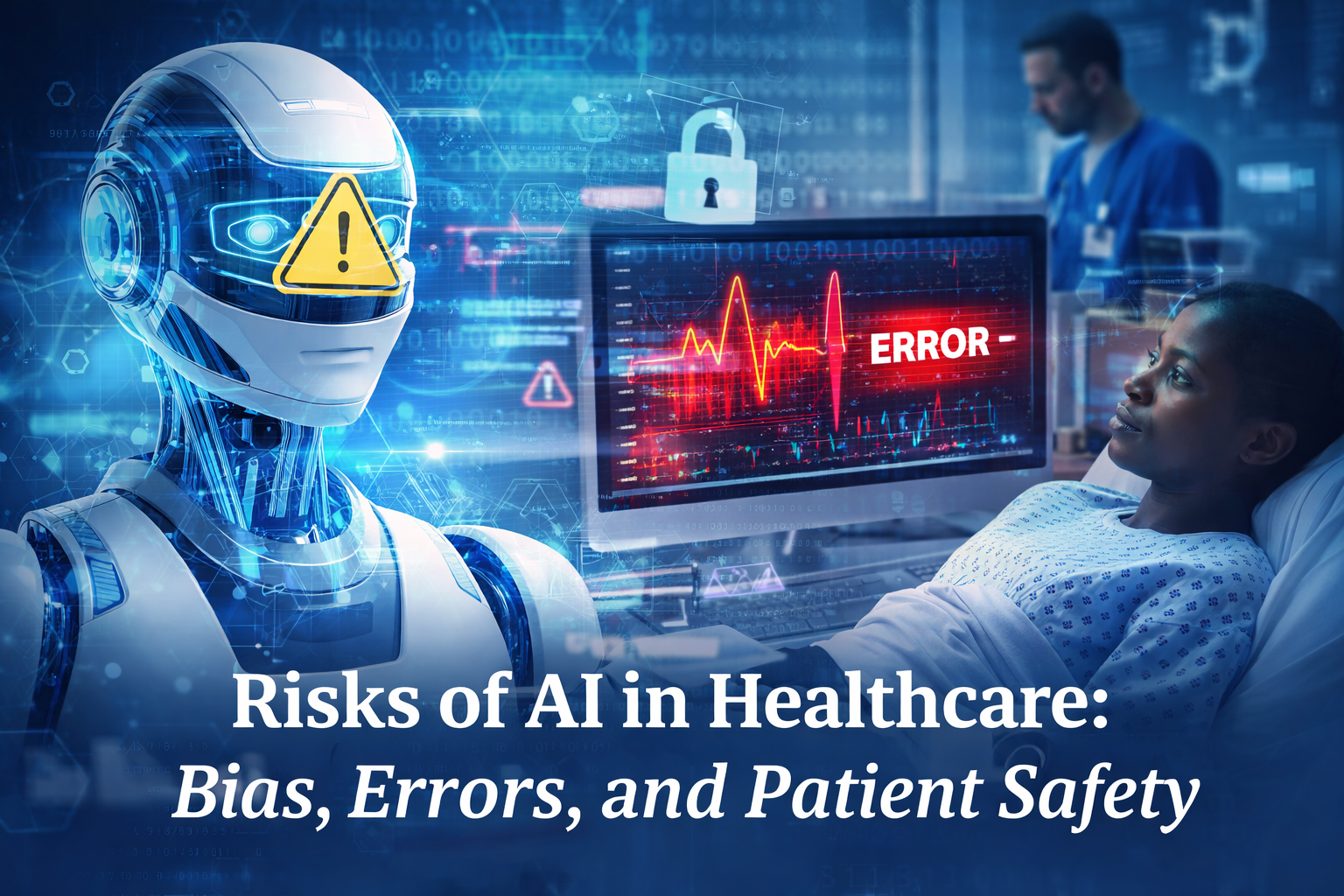
AI is already helping healthcare teams read scans more efficiently, summarise notes, predict demand, and answer routine questions. But healthcare is not like retail or entertainment. If an AI system makes an error here, the impact can be severe: delayed treatment, missed diagnosis, privacy exposure, or unfair care decisions for specific patient groups.
That’s why “AI risk” in healthcare isn’t just a technical topic. It’s a patient safety topic. The goal is not to fear AI—it’s to use it responsibly. This guide explains the major risks clearly (with real examples), and then shows what hospitals and clinics can do to reduce them.
If you want the basics first, read: What is AI in Healthcare?
What Do We Mean by “Risk” in Healthcare AI?
When people ask “Is AI risky in healthcare?”, they usually mean one (or more) of these:
- Clinical risk: AI contributes to a wrong or delayed decision (e.g., missed stroke sign), which can affect outcomes.
- Operational risk: AI breaks workflows or makes them less reliable (e.g., scheduling logic creates bottlenecks).
- Equity risk: AI performs worse for certain groups or encodes unfairness (bias).
- Privacy and security risk: patient information is exposed or misused.
- Accountability risk: unclear responsibility when AI influences decisions.
The important point: risk is not just about the model. Risk also comes from how the tool is deployed, who oversees it, and how humans interact with it.
Major Risks of AI in Healthcare
Bias and Inequitable Care
Bias is the fastest way AI can break trust in healthcare—because it can quietly affect who gets care, who gets follow-up, and who is considered “high risk.”
A widely cited real-world example of AI bias in healthcare was published in Science in 2019. Researchers examined a health risk prediction algorithm used across the U.S. to identify patients for high-risk care management programs. They found that the algorithm systematically disadvantaged Black patients because it used future healthcare spending as a proxy for health need.
Because Black patients historically incur lower healthcare costs due to unequal access and systemic barriers—not lower illness burden—the algorithm underestimated their true health needs. When the model was redesigned to use clinical indicators instead of cost, the number of Black patients identified for additional care nearly doubled.
(Obermeyer et al., Science, 2019)
Why this matters in everyday healthcare:
- If AI is used to decide who gets extra support (care management, outreach programs), biased predictions can mean some patients are left out.
- Bias can show up even if a model never uses race explicitly. It can be “learned” through correlated signals in the data.
What actually reduces bias (practical, not theoretical):
- Measure performance by subgroup (age bands, sex, race/ethnicity where permitted, language, insurance type, comorbidities).
- Avoid proxies like cost when the real target is clinical need.
- Re-check after deployment—because bias can reappear if the patient mix or data changes over time.
Errors from Poor Generalization
A model that works in one system may perform worse in another because medicine is messy: patient populations differ, documentation habits differ, device settings differ, and baseline disease prevalence differs.
A strong proof point is the Epic Sepsis Model (ESM). A widely cited external validation study in JAMA Internal Medicine reported hospitalization-level performance (AUC ~0.63) that was substantially worse than performance figures reported in internal documentation.
What this teaches:
- Internal testing isn’t enough. Healthcare AI needs independent validation and local testing.
- Sepsis is a high-stakes area. Even “moderate” model performance can translate into missed cases and false alarms, which also creates alert fatigue.
How to reduce generalisation risk:
- Local validation before full rollout (test on your own data and workflows).
- Start with limited deployment (a pilot in one unit or site).
- Monitor accuracy continuously and compare to baseline clinical performance.
Automation Bias: Over-Trusting AI Decisions
Automation bias is a human factor risk: when people trust AI too much, especially under time pressure. In healthcare, this often happens in triage, decision support, or documentation workflows.
How it shows up:
- A clinician sees an AI suggestion and accepts it without verifying.
- Staff become “trained” to trust alerts—even when alerts are sometimes wrong.
- The workflow nudges people toward “accept” because it’s faster.
How to reduce automation bias (what works in real workflows):
- Use AI as a second set of eyes, not a final decision-maker.
- Require review for high-risk outputs (e.g., “AI flagged stroke → specialist must confirm”).
- Train staff on AI limitations: when it fails, what false negatives look like, and what “don’t trust it” signals are.
This is not anti-AI. It’s the same logic as aviation: automation helps—but humans must understand the boundaries.
Model Drift and Declining Performance Over Time
Even a good model can degrade after deployment. This is called model drift: the real-world environment changes, so the model’s assumptions stop matching reality.
Why drift happens in healthcare AI:
- New treatment protocols, new coding patterns, new staff workflows
- Changing patient populations
- New devices or scanning protocols
- Seasonal shifts (flu season vs summer)
The FDA has emphasized the importance of a total product lifecycle approach for AI/ML-based Software as a Medical Device, recognizing that ongoing oversight is needed as software changes or learns.
How to reduce drift risk:
- Track performance metrics over time (false positives/negatives, calibration, subgroup performance).
- Create a clear update policy (what changes require revalidation).
- Use a rollback plan if performance drops.
Privacy and Data Security Risks
AI often needs data—EHR records, imaging, lab results, messages, voice transcripts. That creates obvious privacy and security risk if safeguards are weak.
In the U.S., the HIPAA Privacy Rule explains what is protected, who is covered, and how protected health information can be used and disclosed.
HIPAA’s Security Rule establishes standards for protecting electronic protected health information (ePHI) through administrative, physical, and technical safeguards.
Real-life risk patterns hospitals worry about:
- PHI flowing into tools that are not covered by proper agreements or controls
- Weak access controls (“too many people can see too much”)
- Third-party vendors storing or processing data without strong security practices
- Data leakage through logs, integrations, or unsecured endpoints
Practical privacy safeguards to expect in healthcare AI:
- Business Associate Agreements (BAAs) where applicable
- Strong encryption, access controls, audit logs
- Data minimization (only use what’s needed)
- Clear retention and deletion policies
Lack of Transparency and Explainability
Some AI tools are “black boxes.” They output a risk score or a recommendation without a clear explanation. That can be a problem in healthcare because clinicians need to understand why a system is making a suggestion—especially for high-stakes decisions.
Why it matters:
- If a clinician can’t interpret the output, they either ignore it or trust it blindly—both risky.
- Patients increasingly ask, “Was AI involved in my care?” and expect clarity.
Practical mitigation:
- Prefer tools that provide supporting signals (e.g., highlighted regions on an image, factors contributing to a risk score).
- Require vendor documentation: intended use, known limitations, performance metrics, and population tested.
Accountability and Liability Gaps
In real healthcare workflows, AI often sits in between:
- vendor promises (“it improves detection”)
- clinical workflows (“we used it as decision support”)
- operational policies (“who must review it?”)
The risk is confusion: if something goes wrong, was it a clinician error, a vendor error, a workflow error, or a governance error?
The safest approach in most settings:
- Treat AI as a support tool, not a replacement for clinical judgment.
- Document how AI is used (what tasks it supports, who reviews it, what it cannot do).
- Maintain incident reporting, like any other clinical system.
Risks Specific to Generative AI in Healthcare
Hallucinations and Confidently Wrong Answers
Generative AI tools can produce outputs that sound convincing but are incorrect. In healthcare, that’s dangerous because language can influence decisions.
WHO has published guidance for large multi-modal models in health and has repeatedly emphasized governance and safety concerns—especially around accuracy, bias, and appropriate oversight for fast-moving generative systems.
Why hallucinations are high risk:
- A patient may delay care because the answer sounded reassuring.
- A clinician may assume a summary is accurate when it contains subtle errors.
- A generated “plan” may not match guidelines or patient context.
Practical rule:
- Generative AI can assist with drafts and summaries—but must be reviewed before clinical use.
Fake or Fabricated Medical Citations
A known failure mode of generative models is “citation hallucination”—inventing references or linking unrelated sources. In healthcare writing or internal clinical documentation, this is especially risky because it can create false confidence.
How to mitigate:
- Require citations to be clickable and verifiable.
- Prefer quoting and citing primary sources (FDA, WHO, peer-reviewed journals).
- Use a workflow where a human checks citations before publishing or deploying content.
Prompt Sensitivity and Inconsistent Outputs
Generative AI outputs can change based on phrasing, context length, or missing details. In medicine, small details matter.
What this means in practice:
- Two staff members ask the same question differently, and they get different answers.
- A missing piece of context (age, comorbidities, current medications) can change the output entirely.
Mitigation:
- Use standardized prompts for operational tasks.
- Avoid using generative AI for definitive clinical judgment without structured guardrails.
Patient Privacy Risks with AI Chat Tools
A major risk is people pasting PHI into tools that are not approved for clinical use.
Tie-in to HIPAA basics:
- HIPAA Privacy Rule explains protections and permitted uses/disclosures of PHI.
- HIPAA Security Rule focuses on safeguards for ePHI (confidentiality, integrity, availability).
Mitigation:
- Use approved tools with proper agreements and security controls.
- Train staff on what data can and cannot be entered.
- Consider redaction workflows for non-clinical drafting tools.
Safe and Appropriate Uses of Generative AI in Healthcare Today
Generative AI can be useful in healthcare when the task is low-risk or when there is strong oversight.
Good uses of Generative AI in Healthcare(with oversight):
- Drafting patient-friendly explanations of a diagnosis (clinician reviews)
- Summarizing long notes for internal review (human verifies)
- Drafting administrative letters, prior authorization narratives (final human check)
- Supporting call center scripts or intake prompts (clinically reviewed content)
Bad uses of Generative AI
- Autonomous diagnosis or treatment advice to patients
- Making medication changes without clinician review
- Generating clinical decisions without validation and governance
WHO’s governance guidance is specifically aimed at safe use and oversight in health settings, which fits this “assist + verify” model.
Risk Differences by AI Use Case
Diagnostic AI (Imaging and Triage Systems)
These tools can be valuable but have high clinical stakes.
Key risks:
- False negatives (missed detection)
- Dataset shift (different scanners/protocols)
- Over-reliance (“AI didn’t flag it so it must be fine”)
Example of a regulated pathway:
- FDA permitted marketing of Viz.AI’s stroke triage software, designed to analyze CT images and alert specialists for suspected large vessel occlusion.
Mitigation:
- Clear escalation policies
- Specialist confirmation for high-stakes outputs
- Regular auditing of misses and false alarms
Predictive Models (Sepsis, Readmissions, Deterioration)
Predictive AI is popular because it promises early warning. But “prediction” is not the same as “clinical truth.”
Key risks:
- Alert fatigue
- Poor calibration (risk scores don’t match reality)
- Hidden confounders (models learn patterns that don’t generalize)
Proof that external validation matters:
- Independent evaluation of the Epic Sepsis Model showed weaker discrimination and calibration than expected, raising concerns about widespread adoption without strong validation.
Mitigation:
- Evaluate both discrimination (AUC) and calibration
- Focus on actionable alerts (what staff can do when an alert fires)
- Monitor net benefit: does it improve outcomes or just increase noise?
AI Scribes and Documentation Tools
Documentation AI reduces workload but can introduce new risks.
Key risks in AI Scribes:
- Missing clinical nuance (“patient denied chest pain” vs “patient described pressure”)
- Misattribution (mixing who said what)
- Consent concerns if ambient recording is unclear
Mitigation:
- Make “review and sign” mandatory
- Use structured templates where possible
- Make patient consent and disclosure routine
Patient-Facing AI and Symptom Checkers
These tools may improve access, but they also create safety risk if patients delay care or misunderstand guidance.
Key risks:
- False reassurance (patient doesn’t seek urgent care)
- Over-escalation (unnecessary anxiety and utilization)
- Misunderstanding due to language/health literacy
Mitigation:
- Clear safety language (“If X happens, seek urgent care”)
- Easy escalation to human support
- Routine content review by clinicians
Operational AI (Scheduling, Beds, OR Optimization)
Operational AI often feels low-risk because it doesn’t “diagnose.” But it can still affect outcomes by shaping access.
Key risks:
- Equity trade-offs: optimization may prioritize efficiency over fairness
- Workflow brittleness: when reality deviates from assumptions, delays can worsen
- “Gaming” or unintended behavior if staff learn how the algorithm behaves
Mitigation:
- Include equity metrics (who gets access, who waits longer)
- Keep humans empowered to override
- Use continuous monitoring and periodic re-tuning
How Hospitals Reduce AI Risk in Practice
Governance and Oversight Teams
The first step isn’t “buy AI.” It’s “decide how you approve and monitor it.”
A practical governance group includes:
- clinical leaders
- nursing representation
- quality/safety
- compliance/privacy/security
- IT/data teams
- operations leadership
For higher-stakes tools, align governance with risk frameworks. NIST provides a voluntary AI Risk Management Framework focused on managing AI risks to individuals and organizations.
Validation Before Deployment
Hospitals reduce harm by validating AI locally, not just trusting vendor brochures.
Minimum pre-deployment checks:
- Does it work on your population?
- Does it work on your equipment and workflow?
- Does it perform well across subgroups?
- What happens on edge cases?
- What is the “human review” requirement?
This is exactly why external validation examples (like the sepsis model) are so important: they show what happens when tools are widely adopted without adequate local testing.
Continuous Monitoring After Deployment
Good AI programs treat deployment as the beginning, not the end.
Monitoring should include:
- accuracy and false-alarm rates
- subgroup performance
- workflow impact (time saved vs added burden)
- safety incidents and near-misses
- drift signals (accuracy trending down)
FDA’s AI/ML SaMD resources and action plan emphasize lifecycle thinking for software oversight.
Human-in-the-Loop Requirements
The simplest safety concept: AI can support, but humans must remain responsible, especially when stakes are high.
Human-in-the-loop works best when:
- it is explicitly built into workflow (“AI suggests → clinician confirms”)
- escalation paths are clear
- override is easy (no friction to disagree with AI)
This also reduces automation bias because the system expects verification.
Transparency for Clinicians and Patients
Transparency reduces confusion and increases trust.
What transparency looks like in practice:
- clinicians know when AI is used and what it’s intended to do
- patients are told in plain language when AI supports a service (especially for communication tools, recordings, or triage systems)
- limits are clear (“this tool does not diagnose; it supports triage”)
This aligns with the broader governance direction emphasized by WHO for generative systems in health settings.
FAQs: Risks of AI in Healthcare
What are the biggest risks of AI in healthcare?
The biggest risks are biased outcomes, errors that don’t generalize across settings, over-trusting AI outputs, privacy and security failures, and performance decline over time without monitoring. Real-world evidence shows these risks can happen even with widely adopted tools — for example, external validation of the Epic Sepsis Model, a proprietary AI used in hundreds of hospitals, found poor discrimination and calibration when predicting sepsis outside its development environment.
Can AI in healthcare make medical mistakes?
Yes. AI can produce false positives, false negatives, or misleading recommendations—especially if it’s used outside its intended environment or without proper oversight. That’s why independent validation and clinician review matter.
What is AI bias in healthcare?
AI bias happens when an algorithm learns patterns that reflect inequality in the underlying data. A widely cited example showed a health risk algorithm disadvantaged Black patients because it used healthcare cost as a proxy for medical need.
How do hospitals test AI before using it?
Hospitals typically validate tools locally, test performance across subgroups, pilot in limited settings, and define clear oversight rules before expanding use. External validation failures (like sepsis prediction) show why this step is critical.
Does the FDA regulate AI used in healthcare?
Many healthcare AI tools are regulated as Software as a Medical Device (SaMD) and may require FDA authorization before clinical use. FDA also provides guidance and oversight approaches for AI/ML-based SaMD across the product lifecycle.
Is it safe to use generative AI like ChatGPT for medical advice?
It’s not recommended to use general-purpose generative AI for personal diagnosis or treatment decisions. WHO has issued guidance focused on safe and ethical governance for large multi-modal generative models in health settings because incorrect or biased outputs can cause harm.
How is patient privacy protected when AI is used?
In the U.S., HIPAA provides standards for protecting protected health information and requires safeguards for electronic PHI. Healthcare AI deployments should include strong access controls, audit logs, encryption, and vendor agreements where applicable.
Can doctors rely entirely on AI for decisions?
No. AI is best used as decision support. Clinicians remain responsible for final decisions, and high-risk outputs should require human review. The safest deployments use strong governance, validation, and monitoring.
0 Comments